
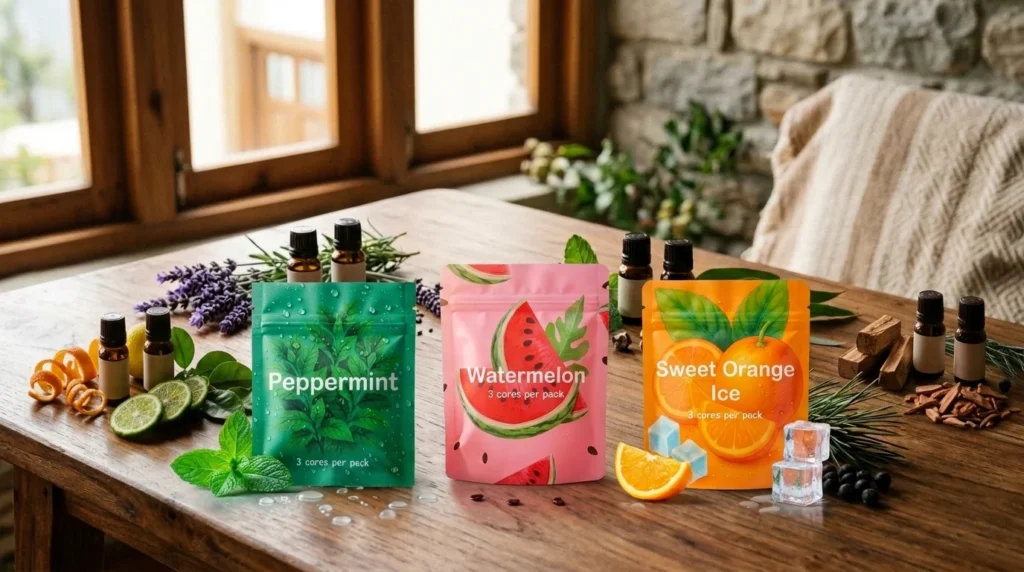
Choosing essential oil aromas is less about finding a universally ‘best’ scent and more about matching intensity, character, setting, and personal preference. A bright aroma that feels clean in the morning may feel too sharp at night. A soft woody profile that suits an evening routine may feel too heavy during a hot commute. Aiir is a men’s health and wellness brand based in Nepal, publishing practical, honest writing on men’s health across body, mind, and life.
This guide explains how to think about aroma families across morning, work, travel, and evening routines without turning scent preferences into medical promises. It also shows how replaceable Aiir Pops cores can let one Aiir Stick move between different personal rituals.
This article is educational, not medical advice. Essential-oil aromas do not treat anxiety, insomnia, fatigue, blocked sinuses, or concentration disorders. Some people are sensitive to fragrance, and concentrated oils can irritate the respiratory tract.
Start With Aroma Character, Not Health Claims
Customers often meet aroma products through claims such as calm, energy, focus, immunity, or sleep. These words are attractive because they promise an outcome. They are also risky when the product has not been clinically tested and approved for that purpose.
A more honest system describes what the customer can actually smell: citrus, mint-like, herbal, floral, woody, resinous, sweet, spicy, or fresh. The person can then decide whether that profile feels suitable for a moment in his day.
For Aiir Pops, names should communicate mood and scent character without pretending to be medicine. A name such as ‘Fresh Start’ can be supported by a clear description like crisp citrus and light herbal notes. A name such as ‘Cure Anxiety’ would cross a serious boundary.
Why the Same Aroma Feels Different to Different People
Scent is personal because memory, culture, environment, intensity, and expectation shape the experience. A plant aroma associated with a family garden may feel comforting to one person. The same aroma may remind another person of cleaning products, medicine, or an unpleasant journey.
Climate matters too. Nepal moves from cold mountain air to humid plains and dense urban heat. A rich aroma may feel pleasant in winter and overwhelming inside a hot vehicle in summer. Product testing and customer guidance should consider realistic environments, not only an air-conditioned studio.
Preference also changes across the day. People often tolerate sharper profiles when alert and lighter profiles when tired. That is not a biological rule. It is a practical observation that should be framed as choice rather than guarantee.
A Simple Guide to Essential Oil Aroma Families
Citrus profiles
Citrus aromas are often described as bright, zesty, clean, or lively. Examples may include lemon, sweet orange, grapefruit, or bergamot-style notes. They can suit men who prefer a clear, recognisable aroma rather than something floral or heavy.
Citrus profiles may work well in a morning routine, before work, or after a long commute. The wording should remain sensory: fresh, crisp, peel-like, light, or slightly sweet. Avoid promising that citrus will create energy or cure low mood.
Mint-like and cooling profiles
Peppermint- or menthol-like aromas feel cooling because of how they interact with sensory receptors, but a cooling sensation is not the same as opening airways or treating congestion. This distinction should be explicit in product education.
Some users like mint-like aromas during study or travel because they feel sharp and familiar. Others find them irritating. Aiir should keep the intensity controlled and include clear warnings for sensitive users.
Herbal profiles
Herbal aromas can include rosemary-like, basil-like, tea-tree-like, or green botanical notes. They may feel clean, earthy, medicinal, or garden-like depending on the blend. Description matters because ‘herbal’ alone is too broad.
A useful label might say ‘green, dry, and lightly camphoraceous’ rather than promising concentration or immunity. The more precise the sensory description, the less the brand needs exaggerated benefit language.
Woody and resinous profiles
Wood, cedar, pine, frankincense-style, or resinous notes can feel dry, warm, smoky, forest-like, or grounded. These profiles often suit customers who dislike sweet or floral scents.
A woody Aiir Pops could fit an evening reading ritual, travel routine, or quiet work setting. Again, ‘grounded’ may describe the mood of the brand experience, but the label should not claim to medically reduce stress.
Floral profiles
Lavender, rose, jasmine, and other floral notes vary from soft and powdery to rich and sweet. Men’s wellness branding sometimes avoids floral aromas because they are treated as feminine. That is an unnecessary limitation. Scent preference is individual.
The challenge is intensity. A strong floral core can become overwhelming in a small personal device. Aiir should test concentration carefully and describe the profile honestly so customers know whether it is dry, sweet, soft, or bold.
Spicy and sweet profiles
Cinnamon-like, clove-like, vanilla-like, and sweet spice aromas can feel warm and distinctive. Some spicy oils may also be more irritating, so formulation and safety review are especially important. ‘Natural’ is not a shortcut around toxicology or dosage.
Choosing an Aroma for the Morning
Morning is a transition from sleep into activity. The best aroma is one you find pleasant at low intensity and can associate with a simple start-of-day sequence: open the curtains, drink water, wash, check the plan, then use the scent cue briefly.
Bright citrus, green herbal, or light mint-like profiles may be reasonable options for customers who enjoy them. The aroma should not be presented as replacing sleep, breakfast, hydration, daylight, or medical care for persistent fatigue.
If you use Aiir Pop in the morning, keep the sequence consistent. Insert the compatible core correctly, use it as directed, cap the Stick, and move into the first task. The product should help mark the routine, not delay it.
Choosing an Aroma for Work or Study
A work aroma should be discreet, not so strong that it becomes another distraction. Personal devices are useful here because they avoid filling the room. Still, do not use fragrance near colleagues who are sensitive, and never assume that ‘personal’ means no one else can notice it.
Crisp citrus, clean herbal, dry woody, or mild mint-like profiles may suit different preferences. The real focus system should include one task, reduced notifications, enough light, a clear time block, and regular breaks.
A useful internal link is Pocket Aromatherapy for Men, which explains how the scent cue should connect to action rather than a vague promise of productivity.
Choosing an Aroma for Travel
Travel exposes you to unfamiliar rooms, changing schedules, crowded transport, and long waiting periods. A familiar aroma can become a small personal constant. Choose something mild, widely tolerable, and securely packaged.
Do not use the device when driving, riding, crossing roads, or doing any activity that requires full attention. Keep the refill in original labelled packaging when travelling and check airline or border rules for essential-oil products.
In Nepal, heat inside vehicles and direct sunlight can affect volatile aroma materials. Do not leave Aiir Pop in a hot dashboard, exposed motorcycle compartment, or open bag in rain or dust. Storage is part of product performance.
Choosing an Aroma for Evening
Evening routines work best when they reduce stimulation overall. Dim light, finish work, lower screen use, and keep a regular sleep schedule. A softer aroma may fit this environment if you enjoy it, but the aroma is not a sleep treatment.
Woody, gentle floral, soft herbal, or low-sweetness profiles may feel appropriate. The key is low intensity. If the scent keeps demanding attention, it is not supporting a wind-down.
A useful product name might suggest timing without claiming treatment: ‘Evening’, ‘Quiet’, or ‘Soft Wood’. Packaging should state that individual response varies and that the product is for personal aroma use only.
How Aiir Pop Makes Aroma Choice Flexible
Aiir Pops is the replaceable cotton core used inside Aiir Stick. The refill model means a customer can keep one durable device and change scent profiles as preferences or routines change.
That flexibility creates several possible product sets: a morning and evening pair, a travel pack, a discovery set, or a simple three-aroma starter pack. The commercial idea is strong only if every refill is clearly labelled, sealed, traceable, and formulated to the same safety standard.
Aiir should avoid encouraging customers to keep half-used cores loose in pockets. If a core can be removed and stored for later use, the brand needs a hygienic, airtight storage method. Otherwise, instructions should recommend replacing and discarding it appropriately.
What to Check on an Aroma Product Label
- A clear aroma name and sensory description
- Complete ingredient disclosure required for the market
- Batch or lot number
- Manufacturing and expiry information
- Storage instructions
- Warnings and stop-use symptoms
- Directions for inserting, using, and replacing the core
- Contact details for the responsible company
- A statement that the product is not a vape, nicotine product, or medical inhaler
The FDA explains that aromatherapy product regulation depends partly on intended use and the claims made. A fragrance product marketed to treat disease can be regulated differently from a product marketed only for scent. Review the FDA aromatherapy overview.
Safety: More Aroma Is Not Better
Essential oils are concentrated. A pleasant low-level aroma can become irritating when concentration is too high or exposure is too frequent. The finished Aiir Pop blend needs product-specific safety review for the intended personal inhalation method.
- Use only as directed and do not force deep or repeated inhalation.
- Stop if the aroma causes coughing, burning, headache, nausea, dizziness, wheezing, or shortness of breath.
- Do not swallow the core or apply the blend to skin or eyes.
- Keep away from heat, flame, children, and pets.
- Do not combine different oils or add homemade blends to the core.
- Seek medical advice before use if you have asthma, COPD, significant allergies, fragrance sensitivity, or pregnancy-related concerns.
A Four-Aroma Starter Framework for Aiir
| Moment | Possible scent direction | Safe positioning |
|---|---|---|
| Morning | Light citrus or green herbal | A crisp aroma for a start-of-day ritual |
| Work | Dry herbal, mild mint-like, or clean woody | A discreet cue before a focused block |
| Travel | Familiar, low-intensity fresh profile | A portable personal aroma for transitions |
| Evening | Soft woody, floral, or gentle herbal | A quiet aroma for a wind-down routine |
These are product-development directions, not medical outcomes. Final scent names should be tested with Nepali consumers across age groups, climates, and cultural preferences rather than copied directly from Western aromatherapy brands.