
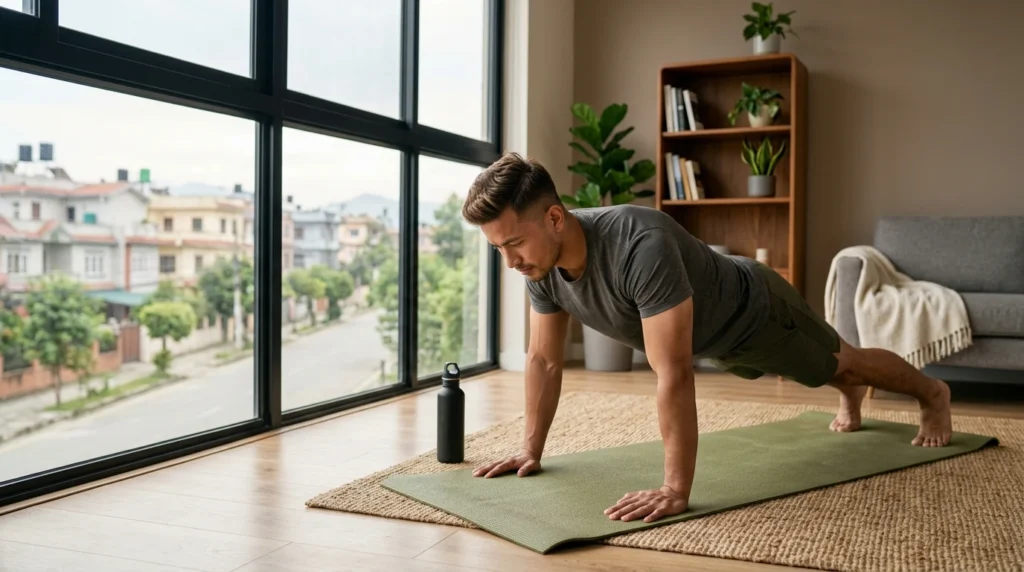
A good home workout does not need machines, expensive equipment, or a perfect schedule. It needs a clear plan, enough effort, and exercises you can repeat without making your life complicated. Aiir is a men’s health and wellness brand based in Nepal, publishing practical, honest writing on men’s health across body, mind, and life. This guide gives you a simple no-equipment routine for strength, conditioning, and consistency.
Most men fail at training at home for one quiet reason: the workout is either too random or too ambitious. One day it is 100 push-ups. The next day it is nothing. A better approach is to treat your floor, wall, stairs, and bodyweight as your basic gym. You do not need more motivation. You need a repeatable structure.
This article is general information and education, not medical advice. If you have chest pain, dizziness, joint injury, high blood pressure, or any medical concern, speak to a qualified doctor before starting a new exercise programme.
What makes a home workout effective?
An effective routine trains the major movement patterns: squat, hinge, push, pull, core stability, and conditioning. You can do this without equipment if you choose exercises carefully. A bodyweight squat trains the legs. A push-up trains the chest, shoulders, and triceps. A hip bridge trains the glutes and hamstrings. A plank trains the trunk. Fast walking, stair climbing, mountain climbers, or low-impact intervals improve conditioning.
The goal is not to destroy yourself every session. The goal is to finish the workout feeling like you did enough work to improve, but not so much that you avoid training for the next four days.
Health authorities generally recommend adults aim for regular aerobic activity and muscle-strengthening work across the week. The CDC’s adult physical activity guidance is a useful reference for the weekly baseline. Your home plan can fit inside that larger target.
Home workout plan for men: the weekly structure
Use this four-day structure if you are starting from zero or returning after a long break. It gives enough frequency to build momentum without making recovery impossible.
- Day 1: Full-body strength
- Day 2: Light cardio or brisk walking
- Day 3: Full-body strength
- Day 4: Rest or mobility
- Day 5: Conditioning and core
- Day 6: Optional walk, sport, hike, or easy movement
- Day 7: Rest
This is not a punishment schedule. It is a rhythm. If your week is busy, keep the two strength days and one walk. That is the minimum version. If your energy is high, add the conditioning day. Build the habit first, then build the workload.
The no-equipment routine
Start with a five-minute warm-up. March in place, rotate your shoulders, do 10 bodyweight squats, 10 arm circles each way, 10 hip hinges, and 20 seconds of easy jumping jacks or step jacks. Warm-ups are not decorative. They make the first working set feel smoother.
Workout A: Strength foundation
- Bodyweight squats: 3 sets of 10–15 reps
- Push-ups: 3 sets of 6–12 reps
- Hip bridges: 3 sets of 12–20 reps
- Reverse lunges: 2 sets of 8–10 reps per leg
- Plank: 3 rounds of 20–45 seconds
- Wall sit: 2 rounds of 30–60 seconds
Rest 60–90 seconds between sets. If regular push-ups are too hard, do them with your hands on a table, bench, or wall. If squats feel too easy, slow the lowering phase to three seconds. Tempo is free resistance.
Workout B: Conditioning and abs workout at home
- Mountain climbers: 30 seconds
- Squat to reach: 12 reps
- Incline or regular push-ups: 8–12 reps
- Dead bug: 10 reps per side
- High knees or step jacks: 30 seconds
- Side plank: 20–30 seconds per side
Move through the list as a circuit. Rest one minute after each round and complete 3–5 rounds. This gives you workout exercises at home that train your heart, legs, chest, and core without needing space beyond a yoga mat-sized area.
How to make chest workouts at home actually work
Most men think home training is weak because they only know one push-up. The push-up is useful, but it can be adjusted. Incline push-ups are easier. Regular push-ups are standard. Slow push-ups increase time under tension. Diamond push-ups shift more work to the triceps. Decline push-ups make the upper chest and shoulders work harder.
Use progression like this: start with incline push-ups for 3 sets of 10. When you can do 15 clean reps, lower the incline. When regular push-ups reach 3 sets of 15, slow the descent. You do not need to chase circus exercises. You need clean reps that get harder over time.
How to progress without equipment
Progressive overload means gradually asking your body to do more. In the gym, that usually means heavier weights. At home, you have other options.
- Add reps until you reach the top of the range.
- Add one extra set to the main exercise.
- Slow the lowering phase of each rep.
- Reduce rest time slightly.
- Move to a harder variation.
- Train one side at a time, such as split squats instead of squats.
The best progression is the one you can measure. Write down your sets, reps, and how hard the session felt. A basic note on your phone is enough. If you did 3 sets of 10 push-ups this week and 3 sets of 12 next week, that is progress.
Common mistakes men make with home training
The first mistake is doing only abs. Core training matters, but visible abs depend heavily on overall body fat, diet, sleep, and consistency. The second mistake is training to failure every day. That sounds intense, but it usually leads to sore joints and poor habits. The third mistake is changing the plan every week because a new video looks exciting.
Keep the same routine for four weeks. Make small improvements. Then adjust. Boring training works because it gives your body a clear signal.
Simple 4-week home workout schedule
| Week | Goal | Progression |
|---|---|---|
| Week 1 | Learn the exercises | Use easy variations and leave 2–3 reps in reserve |
| Week 2 | Add confidence | Add 1–2 reps per set where possible |
| Week 3 | Add workload | Add one set to squats or push-ups |
| Week 4 | Improve quality | Slow the reps and keep cleaner form |
After week four, repeat the same structure with harder exercise versions. That is how a simple home plan becomes a real training system.
How to adjust the routine for your level
If you are completely new, make every exercise easier for the first two weeks. Use incline push-ups, shallow squats, shorter planks, and longer rest periods. Your first job is to learn the movement and finish the session with confidence. A routine that leaves you limping after day one is not better. It is just harder to repeat.
If you already train sometimes, make the same plan more demanding. Use slower reps, deeper ranges, paused squats, decline push-ups, single-leg hip bridges, and shorter rest periods. The structure stays the same, but the difficulty rises. That is the useful part of bodyweight training: the plan can meet you where you are without needing new equipment every week.
Conclusion: Start smaller than your ego wants
The best no-equipment plan is not the hardest routine on the internet. It is the one you can do this week, repeat next week, and improve the week after that. Start with two strength sessions, one conditioning session, and a few walks. Track the basics. Keep it clean.
For more simple training guides, explore Aiir’s Fitness & Training section, read more across the Body pillar, or visit the Aiir shop when you want practical tools that fit into your daily routine.