
A good mobility training program does not replace strength work. It makes strength work safer, smoother, and more useful in real life. Most men train muscles they can see, then wonder why their hips feel locked, their shoulders pinch, or their lower back complains after a normal week. Aiir is a men’s health and wellness brand based in Nepal, publishing practical, honest writing on men’s health across body, mind, and life. This guide explains how to combine strength and mobility without turning your routine into a two-hour stretching session.
This article is general fitness education, not medical advice. If you have pain, injury, dizziness, or a medical condition, speak to a qualified doctor or physiotherapist before starting a new routine.
What is strength and mobility training?
Strength and mobility training is the combination of controlled resistance exercises and active joint movement. Strength builds the engine. Mobility improves how well the engine can move through usable ranges. Flexibility is usually about how far a muscle can lengthen. Mobility is about whether you can control that range while moving, lifting, squatting, reaching, rotating, or carrying.
That difference matters. A man who can touch his toes may still collapse in a squat because he lacks hip control. Another man may bench heavy but struggle to raise his arms overhead without arching his back. Mobility shows up when the body needs coordination, not just looseness.
The practical goal is simple: move better, lift better, and feel less restricted during ordinary life. That could mean squatting without knee discomfort, pressing overhead without shoulder irritation, running without stiff ankles, or sitting at a desk without feeling folded in half by evening.
Why most men skip mobility training
Most men skip it because it feels less rewarding than lifting. A heavier deadlift gives instant feedback. A better hip capsule does not look impressive in the mirror. Mobility also has a reputation problem. Many people imagine long passive stretches, yoga poses they cannot hold, or warm-ups that feel like punishment before the real workout begins.
The solution is not to become a mobility specialist. The solution is to make mobility useful enough that you actually keep doing it. Five to ten minutes before training can improve movement quality. A short reset after long sitting can reduce stiffness. Two focused sessions per week can help joints regain control without stealing recovery from strength work.
Mobility becomes easier to respect when you link it to performance. Better ankle mobility can improve squats. Better thoracic rotation can improve pressing and pulling. Better hip control can make lunges, hinges, and running feel cleaner. It is not extra. It supports the work you already care about.
How a mobility training program fits into weekly fitness
The Centers for Disease Control and Prevention says adults need regular aerobic activity and muscle-strengthening activity each week, including at least two days of strengthening activities. Mobility does not cancel those basics. It helps you perform them with better control. You can read the CDC’s adult activity guidance here: CDC adult physical activity guidelines.
A practical weekly setup can look like this: strength training three days per week, low-intensity walking or cardio two to four days per week, and mobility sprinkled throughout. The best mobility plan is not the most complex one. It is the one attached to habits you already have.
Try this rule: mobilise what you are about to use. Before a lower-body day, open the ankles, hips, hamstrings, and adductors. Before an upper-body day, prepare the shoulders, upper back, wrists, and chest. Before a full-body session, choose one drill for each major area instead of doing everything.
The 20-minute strength and mobility routine
This routine is designed for men who want a simple starting point. It can be used on a rest day, before a lighter workout, or as a two-day-per-week base. Move slowly. The aim is control, not speed.
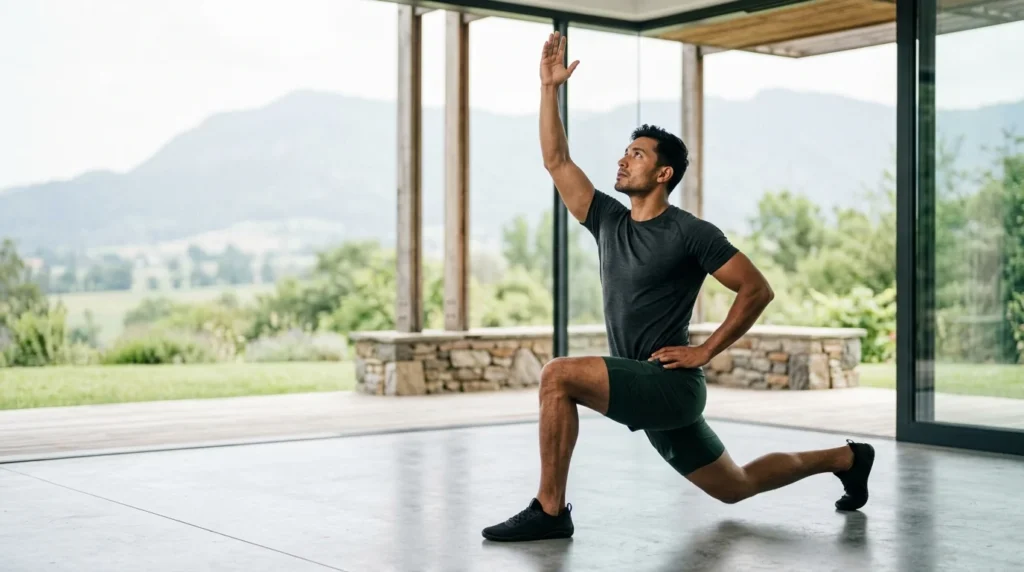
1. World’s greatest stretch — 5 reps per side
Step one foot forward into a deep lunge position. Place both hands near the front foot. Drop the elbow toward the floor, then rotate the same arm upward and look toward your hand. This opens the hip flexor, hamstring, adductors, and upper back in one movement. Keep the back leg active and avoid collapsing into the lower back.
2. Deep squat hold with breathing — 45 seconds
Stand with feet slightly wider than shoulder-width. Lower into a squat and hold a comfortable depth. If your heels lift, place them on a small book or folded towel. Breathe slowly and use your elbows to gently guide the knees outward. This drill trains hips, ankles, and relaxed control at the bottom position.
3. Push-up to downward dog — 8 reps
Perform a controlled push-up, then push the hips back and up into a downward dog position. Keep the shoulders away from the ears and drive the chest toward the thighs. This combines upper-body strength with shoulder flexion, hamstring length, and calf mobility.
4. Split squat — 8 reps per side
Step one foot forward and one foot back. Lower slowly until both knees bend, then drive through the front foot to stand. Split squats build single-leg strength and expose left-right differences. If balance is difficult, lightly hold a wall or chair. Control matters more than depth.
5. Hip hinge reach — 10 reps
Stand tall, soften the knees, and push the hips backward as if closing a car door with your glutes. Reach the arms forward while keeping the spine long. Return by squeezing the glutes. This trains the hinge pattern used in deadlifts, carries, and everyday lifting.
6. Bear crawl shoulder taps — 20 taps
Start on hands and knees, then lift the knees slightly off the floor. Tap the opposite shoulder without twisting the hips. This builds core control, shoulder stability, wrist tolerance, and coordination. Keep the movement quiet and controlled.
How to progress without overcomplicating it
Mobility improves when the body receives repeated, specific signals. Do not change drills every day. Pick five or six movements and repeat them for four weeks. Progress by increasing control, range, tempo, or load. For example, a deep squat hold can become a goblet squat hold. A split squat can become a rear-foot elevated split squat. A push-up to downward dog can become a pike push-up variation.
A better approach is to track one practical marker. Can you squat deeper without your heels lifting? Can you raise your arms overhead without rib flare? Can you sit cross-legged more comfortably? These small checks tell you whether your body is adapting.
Do not chase pain. Mild muscular discomfort is normal. Sharp pain, nerve symptoms, or joint pinching is feedback to stop and adjust. The strongest routine is the one your joints can tolerate long enough to benefit from.
Where strength and mobility training belong in Aiir’s fitness system
If your main goal is muscle, keep strength training as the anchor and use mobility as preparation. If your main goal is long-term movement, give mobility its own short sessions. If you are returning after inactivity, start with the routine above before jumping into heavy lifting.
You can pair this with Aiir’s Fitness section for workout structure, the Mobility & Longevity section for joint health, and the Performance & Vitality section when your goal is better energy and consistency. Equipment is optional. A mat, a light dumbbell, and patience are enough.