Solo travel is one of the cleanest ways to learn how you behave when nobody is managing the plan for you. You choose the route, solve the problems, handle the quiet moments, and come home with a sharper sense of yourself. Aiir is a men’s health and wellness brand based in Nepal, publishing practical, honest writing on men’s health across body, mind, and life. Your first solo trip does not need to be extreme. It needs to be well planned.
Many men like the idea of travelling alone but delay it because they imagine it has to be dramatic: a month across Europe, a trek through the Himalayas, or a remote island with no signal. Start smaller. A first solo trip can be one city, three days, one backpack, and a clear plan.
Why Solo Travel Builds Confidence
Solo travel builds confidence because it removes the usual backup system. There is no friend choosing the restaurant, no group deciding the next move, and no one else responsible for your documents, budget, or safety. That sounds intimidating. It is also the point.
You learn quickly. You learn how to ask for help, how to read a street, how to manage boredom, how to eat alone, and how to stay calm when plans change. These are not travel skills only. They are life skills. A man who can move through an unfamiliar place with awareness usually carries that steadiness home.
The best part is quiet. You realise you can handle more than you thought.
How to Choose Your First Solo Travel Destination
Your first solo travel destination should be interesting, but not unnecessarily difficult. Choose a place with decent transport, safe accommodation options, reliable internet, and enough activities to fill your day without constant logistics. Do not make your first solo trip a test of suffering.
Good first destinations often have walkable areas, hostels or guesthouses with strong reviews, clear public transport, and plenty of other travellers. If you are from South Asia, this might mean a nearby city, a hill town, or a country with simple entry rules and familiar food options. If you are already experienced in travel, you can stretch further.
Use three filters: safety, simplicity, and interest. If a destination fails two of those, save it for later.
Travel Planning Basics Before You Leave
Travel planning does not remove spontaneity. It protects it. In Nepal, this matters because even a simple solo trip can involve changing road conditions, delayed buses, limited phone signal, sudden weather shifts, or confusion around local transport. When your basics are handled before you leave, you can enjoy the journey instead of constantly fixing avoidable problems.
Book your first night of accommodation before arriving, especially in Kathmandu, Pokhara, Chitwan, Lumbini, or any trekking gateway town. Save offline maps, hotel addresses, and nearby landmarks because directions in Nepal are often given through places, chowks, temples, shops, or local reference points. Keep digital and printed copies of your citizenship card, passport, visa, permits, insurance, tickets, and booking confirmations. Share your rough itinerary with one trusted person, including where you plan to stay and when you expect to move to the next place. Check local transport before arrival, whether you are using a taxi from the airport, a tourist bus from Kathmandu to Pokhara, a local bus, a jeep route, or a domestic flight. Keep emergency money separate from your main wallet, and carry some cash because cards and online payments may not work everywhere. Buy or arrange a local SIM card with data if needed, especially if you are travelling outside major city areas.
In Nepal, good solo travel planning also means respecting the route, the weather, and the local pace of travel. A trip that looks short on a map can take longer because of traffic, road construction, landslides, strikes, mountain weather, or limited transport options after dark. That is not a reason to avoid travelling. It is a reason to plan with common sense.
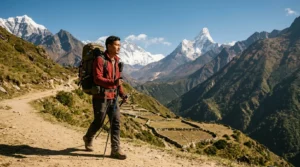
Before going to remote areas, check current route conditions, permit requirements, health needs, and local safety updates. If you are trekking, choose reliable guides or agencies when needed, tell someone your route, and avoid treating the mountains like a casual walk. A confident solo traveller is not careless. He prepares well so he can move freely.
Solo Travel Safety Tips Men Should Actually Follow
Men can become careless because they assume danger is something other travellers worry about. That attitude is expensive. Safety is not about being scared. It is about staying aware without making yourself stiff.
Arrive during daylight when possible. Avoid sharing too much about where you are staying. Do not get drunk with strangers in a place you do not understand. Keep your phone charged. Trust your discomfort. If a street, person, taxi, or situation feels wrong, leave early rather than explaining yourself.
Also, do not confuse confidence with showing off. Flashing cash, expensive devices, or reckless courage is not masculine. It is just poor planning.
How to Handle Eating Alone and Quiet Moments
Eating alone feels strange the first few times because most men are used to meals as social moments. Then it becomes peaceful. Bring a book, sit where you can observe the room, or use the meal as a reset instead of scrolling through your phone the whole time.
Quiet moments are part of solo travel. Do not fill every gap. Walk without headphones sometimes. Sit in a café and write a few notes. Notice what kind of place makes you feel alive and what kind drains you. Solo travel gives you rare feedback because there is no group energy covering your actual preferences.
This is where travel becomes more than content.
How to Meet People Without Becoming Dependent on Them
Solo travel does not mean being alone all the time. Hostels, walking tours, gyms, cafés, language exchanges, and group day trips make it easier to meet people naturally. The difference is that you choose a connection instead of relying on it.
Start with simple lines. “How long have you been here?” “Any food place you recommend?” “Are you doing the same tour tomorrow?” Most travel conversations do not need a perfect opener. They need relaxed curiosity.
At the same time, protect your plan. Do not abandon your route every time you meet someone interesting. Connection is good. Losing your own direction is not.
What to Pack for a First Solo Trip
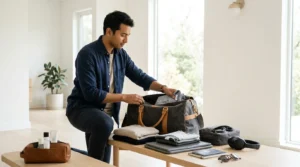
Pack light enough that you can carry your own bag comfortably. A man travelling alone should be mobile. You do not need five outfits for three days or three pairs of shoes for one city. You need clean basics, weather-appropriate layers, a small first-aid kit, chargers, documents, and toiletries that do not explode inside your bag.
A small breathing stick, used lightly and naturally, can also become part of a calm travel ritual before flights, long bus rides, or sleeping in a new room. Keep it optional. The real tool is the ritual: pause, breathe, reset.
Common First Solo Trip Mistakes
The biggest mistake is overplanning every hour. The second is underplanning the essentials. The third is choosing a destination because it looks impressive online rather than because it fits your current travel skills. The fourth is spending too much time documenting the trip and not enough time living it.
Leave open space. One planned activity per day is enough for a short first trip. Add local food, walking, rest, and one spontaneous choice. You are not building a military schedule. You are learning how to move through the world on your own.
Budgeting for a First Solo Trip
A solo travel budget should include more than transport and hotel costs. Add food, local transport, entrance fees, mobile data, laundry, emergency money, and one or two experiences that make the trip worth remembering. Cheap travel becomes stressful when there is no buffer.
Keep two budgets: the expected budget and the survival budget. The expected budget is what you plan to spend. The survival budget is the money you can access if transport fails, accommodation disappoints you, or you need to leave early. That extra layer lets you make safer decisions without panic.